Learn more about my background experience and fieldwork!
Take a journey with me through the hands-on science, research and communication across land and sea I've been apart of!
You can also see my CV here for more :)
F
Latest
Latest
PhD Student and Graduate Research Assistant


— Currently working at this position —
Being a PhD Student so far has been everything and more! From learning about Bayesian Stats more in depth to being charged by an adult female moose, I have thoroughly enjoyed 99% of this position! As you can imagine about grad school, yes, it can be very stressful at points. Ultimately, the good has still very much overweighed the bad though!
As I conclude my first semester and almost first season of calf searches, I have a better idea now of what I want to do. The way I have framed my PhD to look like is following four main chapters.
My first chapter will be a large meta-analysis project that will essentially lay the groundwork for the rest. It will consist of collecting data across hundreds of papers about moose demography across North America. We hope to answer a large ecological question being: "What mechanisms allow for range expansion and what does life on the edge truly look like?". While the study focuses on moose, it will hopefully serve as a framework for better understanding range-edge population dynamics.
Given that moose here in Utah are the southernmost edge-range, I hope to zoom into their population for the next three chapters. With our first being survival. What does adult survival look like, can we look at neonatal survival, what factors influence survival, do moose survive better along this mountain range or the other, and so many more questions. Getting an idea of their survival rate in relation to parasites like winter ticks, climatic-shifts, and age-related actuarial senescence will be a huge goal for this chapter.
Following survival, I hope to understand more about their reproduction. Moose in general can start reproducing at the age of 2 and also give birth to twins, however, here in Utah no moose has been recorded as a 2 year old mom and having twins is extremely rare here. While the overarching goal is to understand reproductive rates and population growth, I hope to also redefine what age-related reproduction looks like for the Shiras Moose vs Alaskan or Eastern Moose. This will be important into better understanding how reproductive phenology and life-history traits may vary across subspecies.
Lastly, now that we know what demography across North America looks like and have zoomed into better understanding survival and reproduction in Utah, we can attempt to figure out how their movement and behavior may impact this. Do they move to higher elevations in winter or lower and vice-versa in spring and summer. Do their peak-activity hours shift in relation to daylight. Do they avoid ticky shrub areas or not. How does their plasticity for environments and where they live impact all of their choices and life-history. Answering questions like these will be important for understanding what mechanisms allow them to be here in Utah but more so, what will the future of their populations look like.
Sea Otter Research Intern
Resting Otter


Otter Carcass Recovery
View with my Xtratufs!
During my time as a Sea Otter Research Intern, I had the unique opportunity to study predator–prey dynamics with a keystone species in the kelp forest ecosystem.
Much of my work focused on collecting foraging data on Southern sea otters along the Monterey Bay Peninsula as part of a long-term monitoring project. I also contributed to population census counts, mapping where otters were and recording their behaviors, which gave me a deeper understanding of how individual movements connect to broader population trends.
I gained hands-on experience with carcass collection, learning the careful protocols required to study health and mortality. I also completed an independent research project examining how age relates to reproductive performance in sea otters. I found that while older females did not have reduced reproductive success, they were more likely to spend significantly more time with their pups.
This role refined my mark and recapture skills, from identifying flipper tags to using VHF receivers and tracking otters during release events. On field days, I especially enjoyed engaging with the public, answering questions about sea otters, our research, and any other ocean related questions. I am deeply grateful to the SORAC Program at the Monterey Bay Aquarium for giving me the chance to grow as a biologist and deepen my passion for research.


Ask a Scientist Board!
Demonstrating quadrats!
Pictures with Ms. Blue
Visitor Experience Associate

Working at the Seymour Marine Discovery Center for two and a half years was an honor and an experience I’ll carry with me forever. The Center became a place where I grew not only as a student but as a person, supported by an incredible career staff who made it feel like a second home. From joining a staff softball team to handling day-to-day operations, this job shaped much of my undergraduate journey.
Every day brought new opportunities to connect with the public, whether through customer service, sharing research stories on tours, or encouraging someone to become a member. Leading science communication tours, gave me the chance to practice and refine my public speaking skills, which has carried into my scientific presentations.
As a Visitor Experience Associate, my role went far beyond the front desk operations of admissions and purchases. I also coordinated volunteers, helped oversee exhibit halls, and supported after-hours events. I even gained limited experienced into aquarist work, assisting with food prep, tank cleaning and appearance, and limited animal handling.
Being part of the Seymour Center family taught me responsibility, teamwork, and confidence, while also deepening my passion for science communication and education.
Elephant Seal Field Assistant
Breeding Colony
All photos taken from visitor paths
Overlook
Wean Pod!


Being apart of the Beltran Lab was truly one of the most impactful and transformative parts of my life.
I first joined this program my spring quarter of my freshman year. I applied for a field course titled BIOE128L, Biology of Large Marine Vertebrates and became the first and only freshman to ever be in the program. In this course, we were introduced to mark and recapture field research methods working with Northern elephant seals. Additionally, we learned skills in R using the long-term dataset of over five decades. As a class, we each assisted on PhD student, Allison Payne's, project studying reproductive senescence. This was an invaluable experience allowing me to become a co-author on a paper published in Journal of Animal Ecology as a freshman. From this, I went on to become a field assistant in Dr. Roxanne Beltran's lab.
As a field assistant my responsibilities shifted with the seasons. For the juvenile haul out, we focused on collecting resight data on tagged individuals. This consisted of noting down their unique flipper tag ID, arrival date, obvious trauma, and location of haul out. We also deployed biologging instruments onto juveniles as part of the "Rules of Death" project studying juvenile life history.
During the breeding season, things became a lot more hectic, yet so much more fun! Now, with adult males, females, and pups galore all around you, not only were you collecting the same kind of data, but also working as a team to ensure each other's safety. Additionally, we collected data on mom-pup pairs to record maternal behaviors, mark adult females and pups using hair dye to strengthen data collection, and also deploy instruments on post-breeding adult females to track their foraging trips before the molt season.
Near the end of the breeding season, we have a "weaner weighing" season where we go out and collect data on the weans. This consists of collecting fur samples, weighing and measuring them. Through this, we can track mom's foraging success by how heavy her pup is at weaning. What's so unique about this program is that we can track transgenerational effects by being able to have data on hundreds of mom-pup pairs.
Lastly, we have the molt season where we record all the resight data as usual while also recording percent molt status. When individuals are molted enough, we focus on marking as many seals as we can before they depart on their post-molt migration.
Besides the field experience I gained here, I also had the privilege of conducting my own research project for my senior thesis. My project focused on examining reproductive strategies elephant seals exhibit during their final year of life across ages. Through this, I learned how to ask a research question, form a hypothesis, became proficient in R, learned how to write a manuscript and work with complex models using Bayesian Statistics and mixed effect models.
I am forever grateful for everything I learned thanks to Dr. Beltran, Allison Payne, and Beltran lab members. They not only trained me in field biology and research but also mentored me into the scientist I am becoming. I would not be where I am today without the support and example of the remarkable women in this lab.
Sea Turtle Expedition
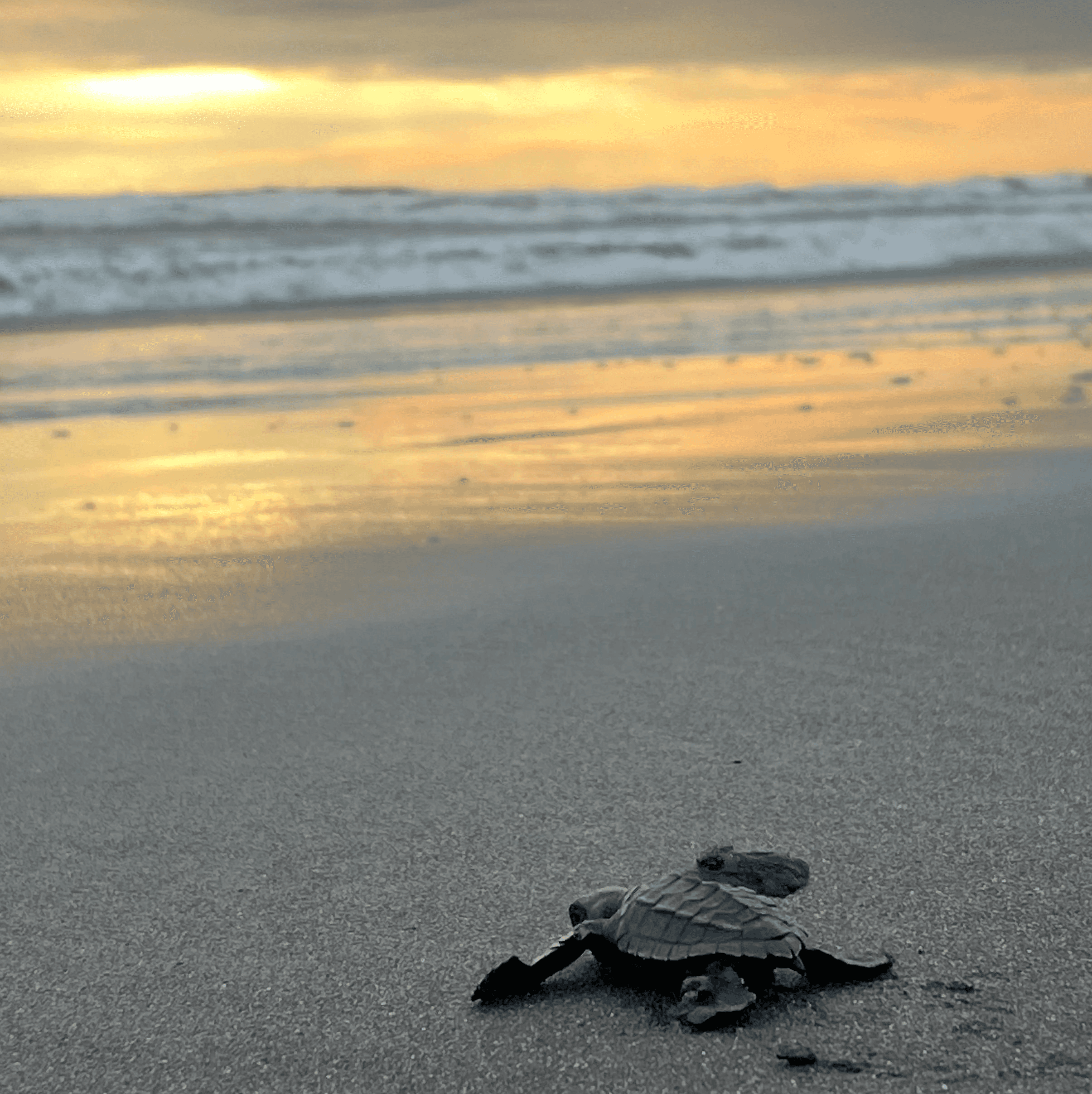
Night Shift
Data Collection
Hatchling <3
Arribada!
While this was a shorter abroad experience, I’m proud to say my first time out of the country was pure Pura Vida.
BIOMA was far more than just a field course in wildlife biology. It immersed me in conservation, culture, and community in a way unlike any other program I have seen. I experienced what real, local conservation looks like, worked directly in the field, and built lifelong memories alongside people who shared my passion.
On our very first night, we witnessed an arribada, a synchronized nesting event where thousands of Olive Ridley sea turtles came ashore to lay their eggs. What at first seemed like a “turtle apocalypse” quickly became one of the most awe-inspiring moments of my life and confirmed for me that this is the field I want to dedicate myself to.
Whether we were conducting population surveys, counting eggs laid per mom, playing soccer with the locals, or simply experiencing Costa Rica’s rich biodiversity, this trip was truly life changing.
Earliest
Feel free to reach out if you have any questions!
——

Bastidas Blog